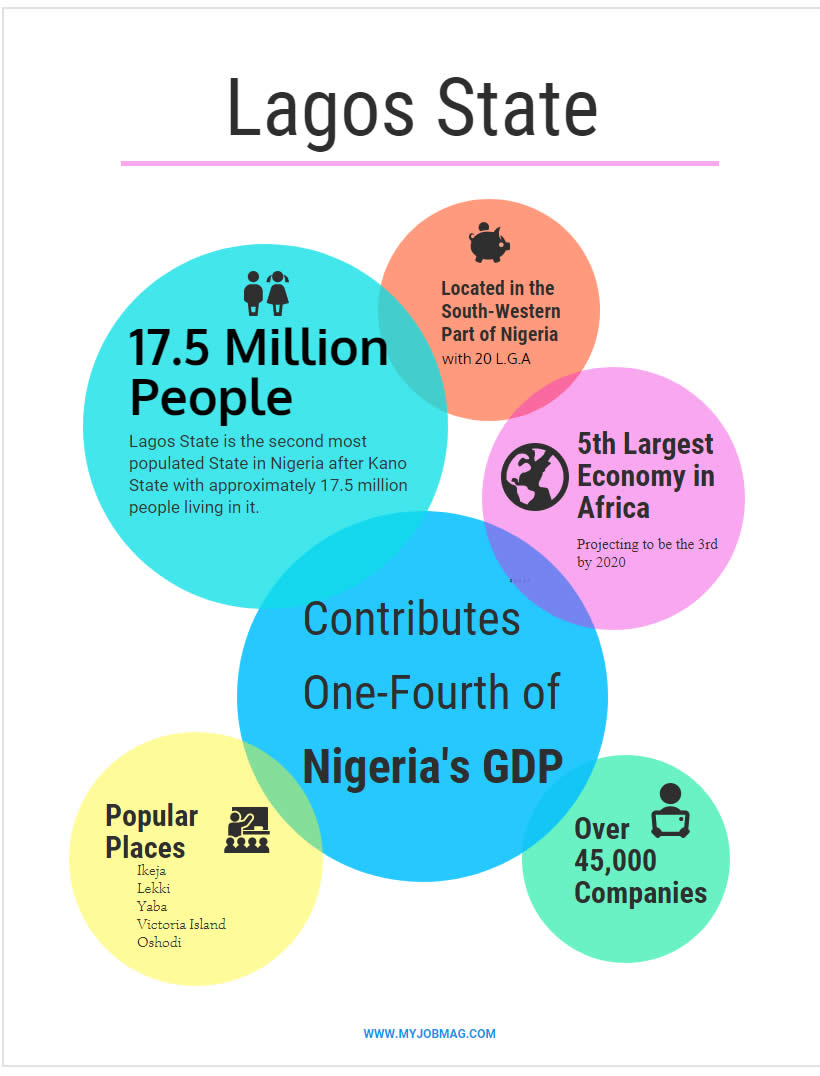
Lagos, sometimes referred to as Lagos State to distinguish it from the Lagos Metropolitan Area, is a state located in the south-western geopolitical zone of Nigeria. It is the smallest state by geographical size in Nigeria. It is arguably the most economically important state of the country, containing Lagos (as a city), and the nation's largest urban area. It is a major financial centre and would be the fifth largest economy in Africa if it were a country. The city attracts professionals from across the country who are eager to explore opportunities among the growing number of jobs in Nigeria.
According to the World Population Review, Lagos State is the second most populated State in Nigeria after Kano State, with approximately 17.5 million people living in it. It has twenty local government areas and various sub-cities and towns within. Most of these cities and towns are commercial areas that give the state the leverage of being the leading economy of the country. Many of these commercial cities and towns are Lagos Metropolitan Area, Ikeja, Lekki, Ikorodu, Eko-Atlantic, Badagry, Epe and Ojo, etc.
The State is Nigeria’s economic focal point, generating a significant portion of the country’s GDP (a quarter). Most commercial and financial businesses are carried out in the central business district situated on the island. This is also where most of the country’s commercial banks, financial institutions, and major corporations are headquartered. These and more are some of the various reasons why many people would want to work in Lagos.
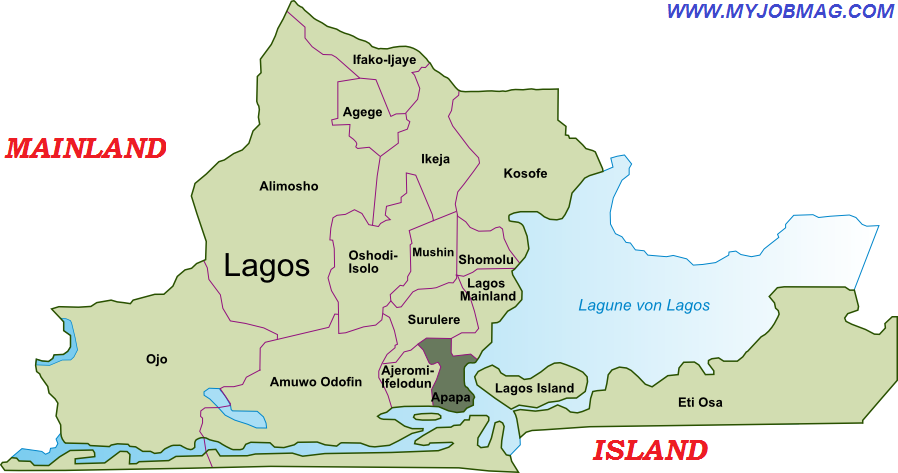
In understanding the state properly and most of the insights to be shared below, it’s important to first understand the state’s geographical categorisation. It is often categorised into two: Lagos Mainland and Lagos Island.
Generally, an Island simply means a piece of land surrounded by water. The Island of Lagos does not take an exception to this definition. Lagos Island is a loose geographical term that is used to define the area of Lagos which is separated from the "mainland" by the main channel draining the lagoon into the Atlantic Ocean. The popular boundary of the island and mainland is what the average man in Lagos knows as the “Third Mainland Bridge”. It is where the people living on the island come through to the mainland, thus serving as the major separation between the two places.
Lagos Island contains the central business district. It is characterised by high-rise buildings. The island also contains many of the city’s largest wholesale marketplaces (such as the popular Idumota and Balogun markets). It also consists of major places like Lekki, Victoria Island, and Ikoyi. The Island is the best place to live in Lagos, especially because of the proximity between the place of residence and the place of work. However, the cost of living on the Island is high. Most of the multinational companies in Lagos and even Nigeria have their headquarters situated in Victoria Island, Lekki or Ikoyi. The sub-islands are separated from each other by creeks of varying sizes and are connected to the main Lagos Island by bridges. The smaller sections of some creeks have been sand-filled and built over time.
A huge population of Lagosians live on the mainland, and most industries are also located there. The mainland is known for its commercial and entrepreneurial activities. Mainland areas include Surulere, Yaba, Agege, Apapa, Mushin, Oshodi-Isolo and Ikeja (site of Murtala Muhammed International Airport and the capital of Lagos State).
Below is a collection of activities of what it looks like working in Lagos. Let’s explore together.
The term cost of living is the amount of money needed to sustain a certain level of livelihood, such as housing, food, health care and some other basic and frequent expenses. Cost of living is often used to compare how expensive it is to live in one city versus another. Lagos State has one of the highest costs of living in Nigeria. In this article, we will be focusing on three of the most common expenses, Accommodation, Feeding, and transportation, and then comparing Lagos State with other states of Nigeria.
Accommodation in Lagos State
Apartments for sale in Nigeria differ in terms of the types and the prices, and also in accommodation. As regarding the types, there are various categories of accommodation that are available for those who intend to work or live in Lagos. The most popular of them are self-contained, mini flats, bedroom flats, etc. Each of these also differs in terms of its price, which is based on location. For example, houses on the island are generally more expensive than those on the mainland.
A self-contained apartment is a single room that has all the facilities such as a toilet, bathroom and most probably a kitchen en suite in it. Based on data from Nigeria Property Centre, a leading real estate agency in Nigeria, the average cost of a self-contained apartment in Lagos is ₦600,000 per year. Some are as low as ₦450,000 per year in the mainland, and others are as high as ₦1M in some parts of the Island.
A mini-flat is an apartment that consists of one bedroom, a sitting room, kitchen, bathroom, and toilet. A mini-flat is akin to a typical "room and parlour". The average cost of a one-bedroom mini-flat apartment in Lagos is ₦1,500,000 per year. Some are as low as ₦1,000,000 per year in the mainland, and others are as high as ₦4,000,000 in some parts of the Island.
Generally, flats are more expensive and could have different numbers of rooms in them, some up to 6 bedrooms. However, the most popular of them are the two- and three-bedroom flats. The average cost of a two-bedroom flat in Lagos is ₦2,500,000 per year. Some are as low as ₦2,000,000 per year in the mainland, and others are as high as ₦9,000,000 in some parts of the Island. The average amount for a three-bedroom flat apartment in Lagos is ₦6,000,000 per year. Some are as low as ₦4,00,000 per year in the mainland, and others are as high as ₦ 15,000,000 in some parts of the Island.

Cost of Feeding in Lagos
Food is the most important of all the basic human necessities of life. Without it, one cannot effectively function or operate at peak performance while working. Feeding in Lagos State is one of the highest cost of living expense which is usually spent at work. While some individuals may find it easy to take breakfast before leaving and even take lunch along to work, this is almost impossible for some other individuals (especially those who work far).
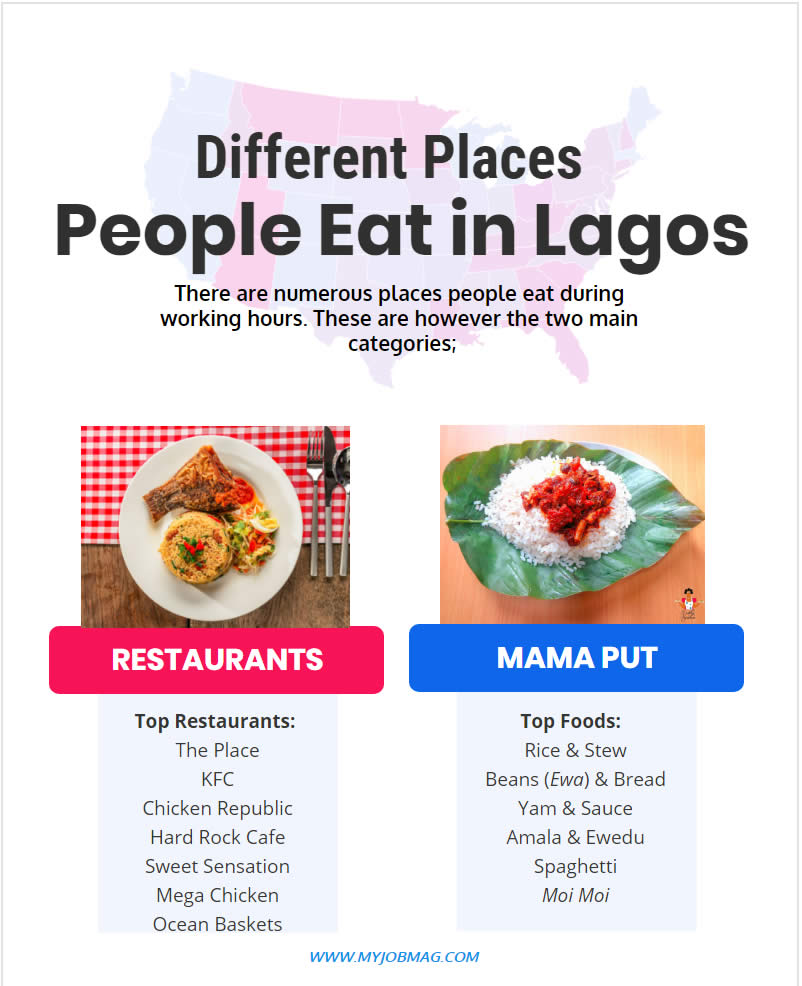
Some firms in Lagos have it as part of their policies to give out lunch to employees on a daily basis or some days of the week. Some other firms make it customary to give free breakfast like tea or coffee. This is, however, untrue for most other firms in Lagos. Feeding, whether breakfast or lunch, is seen as the sole responsibility of the employees. On average, lunch in Lagos costs ₦2000 per meal. There are also various options of places to eat, which also determine the prices. Employees who tend to eat in fast food (eateries) may spend up to ₦ 2,500 per meal, while those who eat in roadside restaurants (popularly called mama put) may spend as low as #1000 per meal.
Some of the popular places to get food in Lagos include:
There also exists a variety of options for delivery. Going to the location in person, ordering via phone call or ordering online.
Cost of Transportation in Lagos
Transportation is also one of the major factors that must be put into consideration before deciding to work in any location, especially Lagos. Lagos becomes very peculiar due to the distance between most places of work and the place of residence. In Lagos where accommodation in the island is very expensive, most of the employees tend to live in the mainland which is very far. Some go as far as leaving home by 5 a.m. to return by 10 p.m. The stress and all can sometimes lead to job dissatisfaction. That is why it must be duly considered.
In terms of transportation costs, using the example of an individual living on the mainland and working on the island, the cost of transportation per day can go as high as ₦4,000 to ₦5,000. Even for those living and working around the same area, transportation costs can still go as high as ₦ 1,000 daily.
Various options of transportation in the state include;
A very important attribute to take note of in Lagos transportation is the “Traffic”. Lagos traffic is so bad that it is said to be the fourth city with the worst traffic in Africa. Traffic is thus part of the core attribute commuters must take into consideration while considering a means of Transportation. However, with the innovations brought in by various online platforms in Nigeria, an individual can easily escape some routes with heavy traffic by following prior details given to them. Leading in this line is an online platform called GidiTraffic, where it uses a Twitter hash tag in achieving this. It is very popular and thus serves as a source of information for most commuters in the state. Many other radio stations make it a duty to also inform people of the traffic situation from 5 pm.
Unlike the vast majority of other states in Nigeria, Lagos is known to have a very competitive salary structure. Generally, the salary structure of most firms in the state could range from base salary, cash bonuses, accommodation, sales commission and even profit sharing. We will focus on the prevalent ones.
Base Salary
Base salary is a fixed amount of money paid to an employee by an employer in return for work performed. Base salary does not include benefits, bonuses or any other potential compensation from an employer. It is paid, most frequently, in a monthly paycheck to a worker or professional employee. According to MyJobMag, the average salary of workers in Lagos State as at the time of this article stands at ₦351,000 monthly. The state has the highest average salary among the other 35 states of the country and the FCT. Some workers in Lagos State earn as much as ₦2,500,000 monthly, while others earn as low as ₦15,000. The salary variations are based on many factors such as company, industry, years of experience, academic qualification, associated risk, etc.
Many teachers earn the lowest salaries in Lagos. While this is true, some teachers earn well (although this depends on the school they teach at). Are you a teacher? See the latest teaching jobs in Lagos
Cash Bonuses
A cash bonus is a lump sum (small amount) of money awarded to an employee, either occasionally or periodically, for good performance. A cash bonus for better-than-expected performance may be awarded to an individual, division or the entire organisation, depending on the level at which performance targets were exceeded. Companies in Lagos do not take exemptions from this. Most firms, however, make it customary to give it periodically, often to crown the end of the year. The average Cash Bonus of an employee in Lagos State stands at ₦40,000, which is often not paid per annum. Some firms, however, pay far more, some less and a few others not at all.
Accommodation Availability
Due to the high cost of accommodation in the state, some employers make it customary to provide their staff or potential employees with accommodation to ease the stress attributed to working in a far-distance place. This is, however, true for only a few firms and is usually common for those in the technology and sales sectors.
Some other corporate organisations, however, go as far as including the accommodation expenses as part of the employees’ benefits and pay them at the end of the year or whenever it’s due.
13th Month Salary
A 13th month salary is a form of monetary benefit equivalent to the monthly basic compensation received by an employee, computed according to the number of months within a year that the employee has rendered service to the employer. This is obtainable in some corporate firms as well in Lagos.
The strength of Lagos lies in providing opportunities to all who come in contact with her. Lagos is a place of unlimited opportunities, especially as it relates to the concepts of jobs, working or money-making.
Job Opportunities in Lagos
According to the Nigerian Bureau of Statistics in 2024, the unemployment rate of the country based on its revised methodology was calculated to be 4.3% in the second quarter of 2024. Under-employment rates also decreased by 1.4% in Q1, with the rate in Q2 2024 reported as 9.2%. With Lagos State housing about 10% of the total Labour force of the country, this gives insight into the unemployment rate in the state also.
However, dense population is profitable for industrial cities, Lagos being a typical one. Over 50% of job advertisements posted daily in Nigeria are situated in Lagos State only. Thus, even though the unemployment rate of the country is high, a large chunk of the job availability is still situated in one state – Lagos. Using MyJobMag gives you a first-hand view of various job vacancies advertised in the country and the state specifically.
There is also a tool that can aid job-seekers in Nigeria in ascertaining the authenticity of job vacancies. Individuals can easily check the CAC database to ascertain if a company is registered in Nigeria when not totally sure of a particular job vacancy.
If the authenticity of a job vacancy has been ascertained, locating the venue of the firm for an interview or application can be difficult for new Lagosians too (popularly called JJCs) and sometimes for even old individuals. Thus, an easy way to locate a company even if you have no idea of the place is to simply enter the address on InstantStreetView. Here, you get an image of the firm in clear view and even get a glance of other buildings on the street. This eventually makes it easy to locate any place in Lagos.
Multiple-Earning Opportunities
Lagos State offers multiple-earning opportunities for workers in the state. A few job positions allow the job-holders to take up other part-time jobs during the week or weekends (if they are able to work both during weekdays and weekends). But this is almost impossible for most workers as they would need the weekend to rest and carry out other domestic activities. However, opportunities abound for those who are able to cope with both. Some examples of jobs that can bring extra earnings are;
Career Growth Opportunities
With the massive number of companies and start-ups in Lagos, it makes it easier for employees to move from job to job, thereby giving them an opportunity to improve in their career. This is unlike some other states in the country, where there are fewer jobs, making it more difficult for people to move from company to company or job to job, thereby reducing the rate of career growth.
Among the various attributes that make Lagos State what it is, entrepreneurship is probably among the topmost. Hundreds of thousands of individuals every day use entrepreneurship as their sole means of livelihood. People sell anything in Lagos, anything at all - products, services, ideas and can even sell ice to an Eskimo. Most start-ups in the country also have Lagos State as their place of launch before extending to other states of the country.
Working Space in Lagos
Among the various needs necessary for entrepreneurs to excel in their daily endeavours is a workspace. These workspaces are provided by various hubs in Lagos. The days of struggling to rent, or build one’s own traditional office before starting a business are dying fast. Indeed, the availability of co-working spaces has made it possible for many small and medium businesses to kick off and run efficiently. Aside from the workspace offered, other basic needs such as electricity and internet are often included in their pay packages. Needless to say, the benefits of co-working spaces cannot be over-emphasised. This could be a pointer to why most incubation hubs in Nigeria also offer co-working spaces as part of their incubation plans.
Lagos is a fast-paced environment and considered as the fastest growing city in Africa, where hustling and bustling is the typical order of the day. The lifestyle and events in the state follow the order of the environment, where things are very unusual compared to what is obtainable in other states of the country. Some of the lifestyles and events to be discussed here include hangouts, nightlife, culture, art places, beaches, music and dance schools, cinemas, libraries, universities, shopping malls, etc.
Hangout in Lagos
There are various places that can serve as platforms for cool hangouts in Lagos. Some of the most popular ones are as follows:
Beach Resorts and Conservation Centres in Lagos
Lagos is not just a commercial mega-city, but also a beautiful one at that. Beach resorts and conservation centres in Lagos are some of the places one can go to escape the daily struggle and noisy environment. There are a great number of beautiful beach resorts and conservation centres in Lagos, among which are the following:
Nightlife in Lagos
Lagos never disappoints fun seekers and the night crawlers. There is never a dull moment in the beautiful city of Lagos, with several spots to visit and have a lot of fun, both day and night. Specifically, these are some of the places for nightlife in Lagos;
Museums in Lagos
Museums display contemporary arts and historical monuments. They help portray the cultural, religious and historical importance of a people. Some of the Museums in Lagos are as follows;
Libraries in Lagos
Libraries play a very important role in promoting the progress of knowledge in every society. Lagos does not take exemption to this. Lagos provides an array of public and private libraries for individuals who are book lovers and knowledge seekers. Some of the libraries in Lagos are as follows;
Universities in Lagos
Lagos State also houses various institutions of higher learning in the country. They have three major universities and a series of other private universities, UNILAG being one of the first in the country. They also have lots of polytechnics and colleges of education. Some are
Music and Dancing Schools
Over the years, some schools in Lagos have not just trained musicians, but also produced successful and popular musicians in the Nigerian entertainment industry. Some of the major music schools in Lagos are as follows:
There are many dance schools that teach dance; however, only a few tailor their dance courses to meet your specific needs. Some of the dance schools in Lagos are as follows;
Cinemas in Lagos
The popular cinemas in Lagos with various branches spread across different areas include;
The exposure an employee gets working for various firms differs from state to state. This is also true for the working environments. With the rapid increase of virtually all commercial activities geared towards technology, most graduates are probably looking forward to working in firms with enough exposure to IT.
Top Companies
As an industrial state, Lagos houses various sky-scrapping firms and huge conglomerates in the country with lots of industry knowledge to learn from and daily commercial activities to wet one’s career appetite with. In terms of the top companies to work in Nigeria, Lagos is probably the headquarters for most. Thus, the state is one of the best places to work in Nigeria when considering exposure and working environment in terms of aesthetics and prestige, as it has lots of big companies with a well-designed workspace.
Modern Technological Tools
Lagos as a city is the heart of modern technology in Nigeria. In all fields of endeavour, new and innovative products or services are often the first to be explored here before they get to other parts of the country. It thus serves as a great place to learn new skills while working and also get the opportunity to come up with witty inventions or ideas via the exposure it offers. So when looking at working in technology-driven firms in the country, Lagos is definitely the first place to consider. The technological exposure it gives is second to none in the country.
Prestige
Lagos has prestige, no doubt about that. It’s one of the states that most potential employees consider first to work in when focusing on status. After leaving the University, most graduates probably want a white-collar job with lots of prestige attached. Lagos is just the perfect place for this.
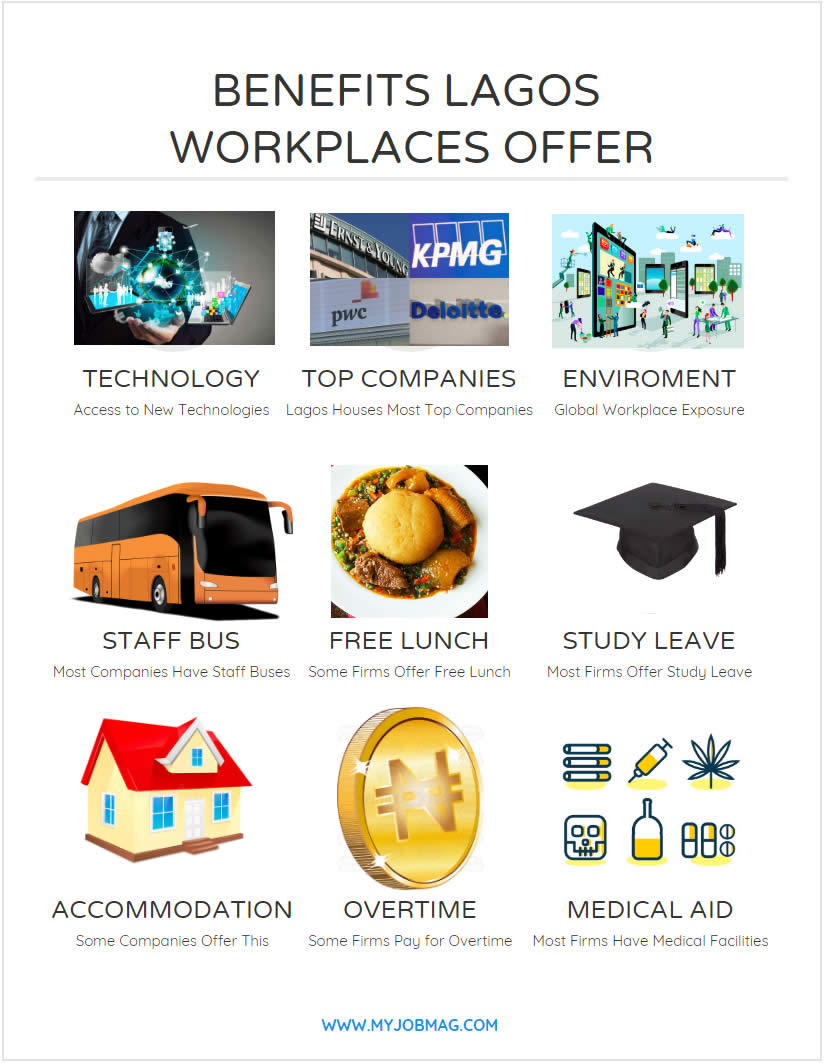
Employee benefits in kind, also called fringe benefits, perquisites, or perks, include various types of non-wage compensation provided to employees in addition to their normal wages or salaries. This ranges from provision of buses for transportation, free lunch, free internet data during office hours, medical care facilities, and various forms of leave.
Staff Bus
Due to the long distance between the residences of most employees and their workplace, and the stress faced by most of them while commuting there, most firms make it part of their policies to provide staff buses for employees on various routes. This is common in Lagos, and most companies do have staff buses that pick up their employees and drop them back at home or at the bus stop closest to them. Benefits of staff buses include reduced stress, leading to increased productivity, punctuality and cost savings for the employees.
Free Lunch
Some Lagos State employees also enjoy free lunch in their firms. While this is daily and constant for some firms, it is, however, rare and intermittent for some other firms. It’s also important to mention that it is almost not attainable in some firms, as those employers see feeding in general as the sole responsibility of the employees.
Free Wi-Fi
With the rapid increase in technology, virtually every firm in Lagos now has a Wi-Fi system for its company that allows the employees to carry out their IT activities smoothly. This also allows the employees free access to internet data for their other personal devices, thereby saving costs. This is common in the state.
Medical Care Facilities/Paid Sick Leave
Working in most firms in Lagos also gives the benefit of medical care facilities where one can treat oneself when under the weather during working hours. In cases where an employee may be seriously sick, and the workplace medical facility becomes insufficient, some employers would offer the employee sick leave to take proper care of himself or herself. Here, the employee is still paid his or her full salary, irrespective of the number of days missed.
Work–life balance is a concept of proper prioritisation of work (career and ambition) and lifestyle (health, pleasure, leisure, and family). Some of the criteria for measuring a positive work-life balance in Lagos are as follows:
Work Leave
A leave of absence is a period of time that one must be away from one's primary job while maintaining the status of an employee. There are various types of leave or time off work to which employees may be entitled. These include annual leave, public holidays, sick leave, maternity leave, paternity leave and etc. There are also times when one may require leave or time off work for specific reasons. This could be when one has a family crisis, or if one wishes to take study leave or a career break. In some cases, individuals are entitled to paid leave, but in others, you may not.
Like every other state, firms in Lagos take their holidays seriously, and employees are entitled to overtime if they work during public holidays.
As regards maternity leave, Lagos State Government has approved 10 days' paternity leave for any male civil servant in the state whose wife delivers a new baby. Female officers are entitled to 24 weeks' maternity leave with full pay in case of their first two deliveries, and this commences, at least, two weeks before the expected delivery date. The length of this leave varies slightly for private companies.
As regards annual leave, most organisation employees are entitled to any of the following lengths of paid leave; some are entitled to a 14-day leave, some 21-day leave and a few others 28-day leave. This depends on their years in the organisation or level of staff they are.
Taking this down to Lagos State, with the labour laws most corporate firms have.
Work Overtime
Work overtime is simply the time spent working at one's job in addition to one's normal working hours. The official time for normal government officials in Lagos State is 8 am to 4 pm. Except for those in the health sector or other fields where night or shift work is required. The official time for most private organisations in the state is 8 am to 5 pm, where some work till 6 or even 7 pm depending on the nature of the job. Any extra time spent working in addition to one’s normal work is tantamount to overtime. Where the worker is supposed to be entitled to an overtime pay. However, this is rarely the case for most firms in the state, though some take exception to this.
Closing Time
Working in Lagos, unlike some other states in Nigeria, may require individuals to stay a little beyond their usual closing time without entitlement to overtime. This is almost usual for most private firms in Lagos. Thus, when planning to work in the state, it is only normal to expect to add at least fifteen or thirty minutes of extra time as demand calls after the actual closing time.
With the insights shared above, one can easily conclude that Lagos State is indeed a great place to work and even live. As reiterated over and over again, the state has lots of benefits that accompany working or living therein, unlike most other states in the country. This does not, however, negate the fact that it can also be very tiresome and thus disadvantageous for individuals who love a slow-paced environment. However, with the concept of cost-benefit analysis, to a large extent one may come to the conclusion that the state has more benefits to the employees, entrepreneurs and business owners than the costs of living in it. Èkó ò ní bàjé oooooo!
Check out our full list of the latest Lagos State Government Jobs here

Hello, we are a team of experienced recruiters and we are happy to help you recruit your next team member.
07066839654
Thank you for this insightful post! Are you looking for credible real estate investment opportunities in Lagos? Check out Land Republic's website for the best property deals and opportunities to invest in real estate seamlessly in Lagos.